|
Eglise Saint Sauveur
The evangelization of
population in the forest of Auge was initiated in the Vth century by
Saint Latuin, honored as first bishop of Seez sent by the
Pope and who faced incredulity and persecution, then by Saint Landry in times
very disturbed by Germanic invasions.
The
Merovingian dynasty
converted to Christendom since Clovis, it is under their patronage that in the
VIIth
century, people saw
Saint Ebrulf settling in the forest of Ouche, where he
founded a hermitage, basis of the important
Abbbey which will be called after him and will provide a safe haven to many monks, of
whom later on, the prolix
Orderic
Vitalis. Other lords, monks and hermits settle, christianize the population, churches are
built and,
Vimoutiers, "relay
for life" in the forest, halfway between Orbec and Trun, would have thus
been named
: Vicus monasterii, the burg of the church.
"Very modest, narrow, described without any chairs nor benches, two small altars
on each side of the nave, recalling the simplicity of the first ages,
certainly originally wooden-made, then rebuilt of limestones of the country, recalling the simplicity of the first ages,
certainly originally wooden-made, then rebuilt of limestones of the country,
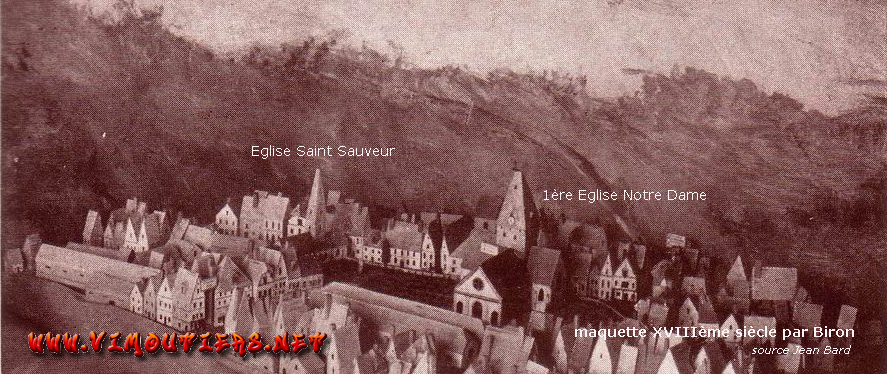
Saint Sauveur Church, located on the market place (map1779)
vis-a-vis the
communal oven, close to the
Hotellerie
des moines,
was included in the properties given indirectly by
Richard I to the Benedictines monks of
Jumieges
in the Xth century, in the circumstances described for the
donation of Vimoutiers.
Certainly, it was a halt of prayers for
pelgrims, because the earliest reference to the
chemins Montais/Ways to Holy Michael Mount
appears
at Vimoutiers
in 1025.
Saint Sauveur Church is
demolished in 1787. Its materials will be used to enlarge the
1ere eglise Notre-Dame.
► Virtual tour :
Abbaye du
Mont-Saint-Michel/Saint Michael Mount
|
|
Saint Latuin
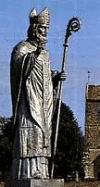
would have been buried at he very
place where the
Chapel of Cleray
was built |
Saint Sauveur Church
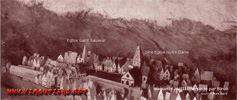
model XVIIIème by Biron
(source Jean Bard)
|
►
Vestiges of Norman Abbeys |